Showing posts with label Devotional. Show all posts

Thursday, April 2, 2020

Dean's Devos: Loving Like Jesus Loved, Part 4

by Dr. John Harvey

In John 13:34-35, Jesus give his disciples (and us) a new commandment:

"So now I am giving you a new commandment: Love each other. Just as I have loved you, you should love each other. Your love for one another will prove to the world that you are my disciples."
(NLT)

When we focus on “loving like Jesus loved,” John 13:1-17 teaches us five lessons about the way he loved:

Lesson #1: 


Jesus loved “to the end” (13:1).

“Jesus . . . having loved his own . . . he loved them to the end.”


There are a two possible understandings of “to the end”—to the full extent of his love or to the very end of his life. Perhaps John had both in mind. The point is that Jesus’ love never failed, and it never faded. He never stopped loving “his own,” and he always gave them the very best he had. Can we say the same about the way we love one another?

Thursday, March 26, 2020

Dean's Devos: Loving Like Jesus Loved, Part 3

by Dr. John Harvey

In John 13:34-35, Jesus give his disciples (and us) a new commandment:

So now I am giving you a new commandment: Love each other. Just as I have loved you, you should love each other. Your love for one another will prove to the world that you are my disciples. (NLT)

Jesus says this commandment is “new” commandment, and the Greek word (καινός) means “new of a different kind.” How is this commandment different from the “great” commandment to love God (Deut. 6:5) and the “royal” commandment to love our neighbor (Jas. 2:8)?

Jesus’ commandment is new, because it carries new significance:


“Your love . . . will prove . . . that you are my disciples.”

Jesus says that loving our brothers and sisters in Christ is the strongest apologetic for Christianity that we can offer. Just as Jesus’ life demonstrated that the Father had sent him, so our love for one another demonstrates that Jesus has sent us.

Thursday, March 19, 2020

Dean's Devos: Loving Like Jesus Loved, Part 2

by Dr. John Harvey

In John 13:34-35, Jesus give his disciples (and us) a new commandment:

So now I am giving you a new commandment: Love each other. Just as I have loved you, you should love each other. Your love for one another will prove to the world that you are my disciples. (NLT)

Jesus says this commandment is “new” commandment, and the Greek word (καινός) means “new of a different kind.” How is this commandment different from the “great” commandment to love God (Deut. 6:5) and the “royal” commandment to love our neighbor (Jas. 2:8)?

Jesus’ commandment is new, because it involves a new standard:


We are to love like Jesus loved (13:34b):

“. . . as I have loved you . . .”
Jesus sets the standard. 1 John 3:16-18 tells us that part of that standard is that Jesus loved sacrificially and actively. That is, we must be willing to lay down our lives for our brothers and sisters. It’s not enough just to say that we love one another. We must practice what we proclaim.

Thursday, March 12, 2020

Dean's Devos: Loving Like Jesus Loved, Part 1


In John 13:34-35, Jesus gave his disciples (and us) a new commandment:

So now I am giving you a new commandment: Love each other. Just as I have loved you, you should love each other. Your love for one another will prove to the world that you are my disciples. (NLT)

Jesus says this commandment is “new” commandment, and the Greek word (καινός) means “new of a different kind.” How is this commandment different from the “great” commandment to love God (Deut. 6:5) and the “royal” commandment to love our neighbor (Jas. 2:8)?

Jesus’ commandment is new, because it is directed toward new subjects:


 We are to love other believers (13:34a):

“Love one another . . .”
The great commandment is directed toward God. The royal commandment is directed toward our neighbor. The new commandment is directed toward our brothers and sisters in Christ and reminds us that our relationship with other followers of Jesus transcends all other human relationships. Human blood might be thicker than water, but Jesus’ blood creates a bond that is even thicker.

Thursday, March 5, 2020

Dean's Devos Part #6 – Ephesians 3:14-19 - What Every Christian Needs

by Dr. John Harvey

This passage is Paul’s second prayer for his readers. It’s a single sentence that divides into four parts.

Paul prays to the Father of our new family (3:14-15).

Paul’s prayer actually has a Trinitarian structure—Father, Spirit, Son. He begins with the Father and highlights God’s fatherhood.

Sometimes, if we have had a bad experience with our earthly father, it becomes difficult to get a proper perspective on our heavenly Father. But Paul has already told us that we have a good, loving, gracious heavenly Father. He is the Father of our Lord Jesus Christ (1:2). He is the Father who has blessed us with every spiritual blessing in the heavens in Christ (1:3). He is the Father of glory, who gives us spiritual wisdom and insight (1:17). He is the Father to whom we have access by the Holy Spirit because of what Jesus has done for us (2:18).

And in these verses, he is specifically the Father from whom “the whole family in heaven and on earth is being named” (3:15). That translation is better than “every family” because Paul has told us that we have a new family to enjoy (2:11-22). And you know what? That family is bigger than we understand. It’s not just the Chapin Presbyterian family. It’s the family of God around the world, and it’s that “so great a cloud of witnesses” in heaven the author of Hebrews describes (Heb 12:1).

It is to that Father whom Paul prays for the Ephesians—and for us.

He asks that the Spirit will strengthen us (3:16-17a).

Paul’s request is clear to see but a little challenging to understand. The first part is understandable—“that we would be strengthened with power through the Spirit in the inner person” (3:16b).

Paul has already prayed that the Spirit would give us wisdom to understand who we are in Christ (1:17-18), and he has already explained the great power that’s ours because God is at work in us (1:19-22). So verse 16 is clear. But what about verse 17a? Doesn’t Christ already live in us (Gal 2:20)? Isn’t Christ in us already the hope of glory (Col 1:27)?

The key is the word Paul uses for “dwell.” When he says in Galatians 2:20 that Christ “lives” in us, he uses the word for “to be alive” (ζαω). When he talks here about Christ “dwelling” in our hearts, he uses a different word (κατοικεω). The word here means “to settle down in permanent residence.” It’s the difference between leasing and owning. It’s the difference between renting space on a part-time basis and settling down as a full-time owner

So, let me ask you: Is Jesus the renter or the owner of your heart? Is he a part-time tenant or a full-time resident? Does the Spirit need to do some work in you so that Jesus can take full control of your heart?

The purpose of his prayer is that we will know Christ’s love (3:17b-19a).

If Christ is truly residing permanently in our hearts, we will begin to comprehend how great his love for us is. It’s as though Paul can’t find enough words to describe it “breadth, length, height, depth . . . that surpasses knowledge.” It’s the similar language to what we sang last week in “Wonderful Grace of Jesus”—“deeper than the mighty rolling sea . . . higher than a mountain, sparkling like a fountain . . . broader than the scope of my transgressions . . . greater far than all my sin and shame. How shall my tongue describe it? Where shall its praise begin?”

Paul prays that the Spirit will help us catch a glimpse of that love. Have you caught that glimpse? Have you begun to live in light of Jesus’ love? If not, isn’t it time to start?

The result will be that we will experience God’s fullness (3:19b).

NASB reads “the fullness of God.” That phrase could mean the fullness that God supplies, or it could mean the fullness that God is. The latter is probably the better understanding: the fullness that God is.

So, what is the result that Paul wants to see in the lives of the Ephesians—and in our lives? He wants to see us become as holy as God is holy and as perfect as God is perfect. What he wants to see is our sanctification.

Sanctification includes three aspects: (past) becoming saints, (future) living as saints in God’s presence, and (present) growing as saints every day. It’s our present sanctification about which Paul is praying here. He wants to see us growing. He wants to see us becoming every day more fully who we already are in Christ.

How are you doing? Are you becoming every day more fully who you already are in Christ? If not, isn’t it time to start?

Jesus gives us new riches to appropriate.

How rich are we? From this passage:
  • We have a Father who has brought us into his family.
  • We have a family that is bigger than the eye can see. 
  • We have the Holy Spirit powerfully at work in us. 
  • We have Jesus dwelling in our hearts through faith. 
  • We are the objects of the love of Christ that surpasses understanding. 
  • We have the potential to experience all the fullness of God. 
It’s like the end of C. S. Lewis’ seventh book in the Narnia series, The Last Battle, where the characters challenge each other to go “farther up and farther in!” Where do you need to go farther up and farther in? Is it understanding more fully who your heavenly Father is? Is it allowing the Spirit to strengthen you with his might? Is it allowing the Son to take up permanent residence in your heart? Is it comprehending more accurately how much Jesus loves you? Is it becoming more fully every day who you already are in Christ?

Will you choose one truth and focus on it this week? Jesus gives us new riches to appropriate. Which aspect of those riches will you appropriate this week?

Thursday, February 27, 2020

Dean's Devos Part 5: Ephesians 3:1-11 – A Stewardship of Grace

by Dr. John Harvey

Let’s take a look at what Paul has to say about this mystery that is the gospel.

Verses 3-7 describe the mystery of the gospel.

Paul’s argument is a little complicated here. It’s as though he begins one idea; then, breaks off to chase another idea; then, returns to his original idea. Regardless, he makes three points about the gospel. First, it was not made known to previous generations (v.5a). Second, God’s Spirit has now revealed it to his holy apostles and prophets (v.5b). Third, it brings the Gentiles into the promise (v.6). That third point is huge and goes back to what we talked about last week—the fact that God has broken down everything that divides us, has us made into one brand new race, and has totally reversed our helpless, homeless, and hopeless condition.

Certainly, the idea was implicit in the OT.
  • Abraham – “In you all the nations of the earth will be blessed.”
  • Jonah – “Go to Nineveh and preach.” 
  • Isaiah – “I have placed you as a light to the nations.” 
  • Psalms – I will give thanks to you, Lord, among the nations.” 
But Jesus made the implicit explicit:
  • Matthew 28 – “Disciple all the nations.”
  • Mark 16 – “Preach the gospel to all creation.” 
  • Luke 24 – “Forgiveness of sins will be preached to all the nations.” 
  • Acts 1 – “You will be my witnesses to the ends of the earth.” 
The message of salvation is now a message that’s for everyone, and Jesus has entrusted it to us as a stewardship of grace.

Verses 8-12 describe the impact of the gospel.

Paul continues by explaining what the preaching of the gospel does. He highlights four results. First, it proclaims the unsearchable riches of Christ (v.8)—and we can never get to the bottom of those riches. Second, it brings to light the mystery that has been hidden in God (v.9)—but now it is revealed in Jesus. Third, it makes known God’s multi-faceted wisdom (v.10)—it’s like a sparkling diamond under a bright light. It fulfills God’s eternal purpose (v.11)—it accomplishes what God has intended since Adam and Eve sinned.

Do you know what’s amazing? What’s amazing is that Jesus entrusted this gospel to his church to make it known to all the nations. Jesus has entrusted the gospel to us as a stewardship of grace. If we don’t share it, no one will.

Verse 13 describes the cost of the gospel.

The last point Paul makes about the gospel is that it comes with a cost. When he wrote to the church in Ephesus, Paul was in prison in Rome. Why? Because of the opposition he encountered among the Jews for preaching the gospel to the Gentiles. But imprisonment wasn’t his only tribulation. Take a look at the list in 2 Corinthians 11:24-27.

What cost are you willing to pay for sharing the gospel with others? A little embarrassment? The possibility of rejection? The possibility of being considered a religious weirdo? Just remember the glory that results when someone responds in repentance and faith (“which is your glory”).

Jesus gives us a new message to share.

That message extends the good news to everyone. It has an amazing impact. it comes with a cost, but when someone responds in repentance and faith it bring glory to God. We talked earlier about the servants entrusted with the talents. They were given stewardship over their master’s money. We have been given a stewardship of grace over something far more important: the gospel.

In Matthew 24:45-46, Jesus asks this question, “Who is the faithful and sensible [steward] whom his master put in charge?” His answer is, “Blessed is that [steward] whom his master finds so doing when he comes.” In Matthew 25:23, Jesus utters the words we should all long to hear, “Well done, good and faithful [steward].” your stewardship of grace this week? Will you hear Jesus say “Well done!”

Thursday, February 20, 2020

Dean's Devos Part #4: Ephesians 2:11-22 – Welcome to the Family

Sermon in a Sentence: Jesus gives us a new family to enjoy.

In this passage, Paul follows the same three steps he used last week: what we were, what God did, and who we are.

Verses 11-12 remind us of what we were then.

Since Paul is writing to Gentiles, he uses Jew-Gentile relations as a case study. The Gentiles had three problems (v.12). First, they were without Messiah (helpless). They had no help available when Messiah came. They were on the outside looking in. Second, they were without citizenship (homeless). They were like illegal aliens with no place to call home. Third, they were without God (hopeless). They had no hope for the future and were living “lives of quiet desperation” (H. D. Thoreau).

Actually, those problems do not simply describe one group of people. They describe each one of us. We were separated; we were isolated; we were alienated. We were away from home and on our own. We were all alone in a sea of humanity. The poet says that no man is an island, but that’s exactly what we were—each of us was an island with no connection to any other island and a lot of water in between.

Apart from Christ, our interpersonal relationships were a mess. The good news is—that was then, but this is now.

Verses 13-18 remind us of what God did.

Verse 13 is where we meet “But now . . .” Verses 13-18 are where we find out about the difference God made in our relationships with one another.

Paul continues talking about Jew-Gentle relationships and says that Jesus’ death had three effects on those relationships. First, his death destroyed the dividing wall (v.14). You see, the Gentiles were forbidden to enter the inner court of the Temple. They were relegated to the Court of the Gentiles. Jesus tore that wall down. Second, his death created a new race (v.15). The word Paul uses (kainos) denotes “new of a different kind.” The new race Jesus was neither Jew nor Gentile; it was Christian. Third, his death gave all of us direct access to God (v.17; cf. Heb 10:19-22). We no longer need to go through a mediator, because there is one mediator between God and man—Jesus (1 Tim 2:5).

It’s not just about Jew-Gentile relations. It’s about every other man-made division as well: black-white, Yankee-Southerner, Democrat-Republican, Carolina-Clemson. God took every division humankind could make and threw all of them into the darkest cave you could ever find, into the depths of the deep blue sea, into the blackest hole in outer space—he made peace among enemies. That’s what’s new: Jesus gives us a new family to enjoy.

Verses 19-22 remind us of who we are now.

“Therefore . . .” marks the conclusion. Jesus has erased all the divisions between Jew and Gentile—and between all of us. In fact, he has done more than erase the divisions; he has brought us together and made us part of something greater than we could ever have imagined. He has made us into his people, his church.

Paul says we are no longer homeless (without citizenship)—we are fellow-citizens of God’s kingdom (v.19). We are no longer helpless (without Christ)—we are fitted together into Christ’s redeemed building (v.20-21). We are no longer hopeless (without God)—we are part of the place where God dwells (v.22). We are now part of a new creation, a new kingdom, a new society. We are now God’s people and God’s family. We now have more in common than natural siblings. And so . . .

Jesus gives us a new family to enjoy.

We were helpless, homeless, and hopeless. We were separated, isolated, and alienated. We were away from home, all alone, and on our own. But now we are fellow-citizens, part of Christ’s building, and the place where God dwells. This new place of belonging is what we call the church. It’s not the building, though. It’s the people. Together we are now the family of God.

If you think about the picture Paul paints, you realize that each of us is uniquely designed and uniquely gifted for a specific role in that family. Each of us has a job to do if the family is going to function properly. Do you know where you fit? Is the family functioning as it should because you are functioning as you are supposed to function?

That’s one aspect. Here’s another. Over in Romans 12, Paul says that members of the family rejoice when others are rejoicing and weep when others are weeping. Why? Because part of being in a family is caring for one another. Do you truly care about the other members of this family? Do you pray for one another? Do you see a need and act on it?

Friday, February 14, 2020

A Valentine's Day Ode to Love

by Dr. John Harvey

Stories on the origin of Valentine’s Day abound. Most likely, February 14 was chosen as the observance of the burial of Valentinius, a priest who lived in the third century. Valentinius ministered to persecuted Christians in Rome, when it wasn’t legal to do so. Part of the legend is that after he healed a lady, he gave her a note signed “your Valentine.” Another part of the legend is that he gave soldiers cut-out parchment hearts to remind them of God’s love. Regardless of the details, the ministry of Valentinius was more about sacrificial love than romantic love. His sacrificial love for persecuted Christians showed others what God looked like. To state that idea as a transferable truth: When we love, others see God in us. That is the truth we see in the three stanzas of 1 John 4:7-12.

The first stanza reminds us that God is the source of love (4:7-8).

Beloved, let us love one another,
because love is from God,
and everyone who loves has been born from God and knows God.
The one who does not love does not know God,
because God is love. 

In verse 7, John states unequivocally that “love is from God.” The Greek preposition he uses paints the picture of “out of from within.” That is, love originates from the very core of who God is. Then in verse 8, John clarifies the reason that God is the source of love: “for God is love.” Love is at the very core of who God is. In his substance, he is “spirit” (John 4:24); in his nature, he is “light” (1 John 1:5) and “love” (1 John 4:8). God is the source of love because he is, by definition, love. He can do nothing other than love, and if we love, we demonstrate that we are God’s children (“born of God”). If others see God’s love in us, it is because he is the source of love. 

The second stanza reminds us that Jesus is the demonstration of love (4:9-10).

God’s love was manifested among us in this,
that God sent his only son into the world that we might live through him.
In this is love,
not that we have loved God,
but that he loved us and sent his son as a propitiation for our sins.

Despite the fact that our love demonstrates that we are God’s children, our love—even our love for God—does not provide a true example of what love is. Only Jesus can do that. Twice John reminds us that “God sent his son,” and he gives two results of that act. In verse 10, John says that God sent Jesus as a “propitiation for our sins.” The idea of propitiation is the satisfying of wrath by a sacrifice. Our pastor in Toronto defined it this way: “God’s frown turns to a smile.” The result in verse 9 follows logically from God’s frown turning to a smile—John says that “we live through him.” Why do we live? Because Jesus died in our place to satisfy God’s wrath. If others see God’s love in us, it’s because he demonstrated love in Jesus. 

The third stanza reminds us that we can be the revelation of love (4:11-12).

Beloved, if God loved us in this way,
we also ought to love one another.
No one has seen God at any time;
if we love one another, God abides in us,
and his love has been fulfilled in us.

John began by writing “let us love one another.” Now, he returns to that idea and says it twice in these verses. In John 13, Jesus taught that our love for one another proves we are his disciples. Here, John says that our love for one another lets others see God in us. That idea is pretty amazing when you consider that John 1:18 says that no one has ever seen God, but the son has “made him known.” When you put this idea together with the rest of Scripture, it teaches us that God reveals himself through creation, through Scripture, through Jesus, and through our love for one another. That last one is both encouraging and challenging. When God abides in us, and when his love is perfectly fulfilled in our love for one another, others see God in us. How’s that for a valentine to the world? 

So, maybe Valentinius gave soldiers cut-out parchment hearts, and maybe he signed a note or two to ladies with “your Valentine.” But God gave the greatest valentine of all: he sent his own son to die for us so that we might live for him. And now, we can reveal God’s love to a watching world by loving one another like Jesus loved us. When we love, others see God in us.

Thursday, February 13, 2020

Dean's Devo's: Part #3: Ephesians 2:1-10 – “But God . . .”


Sermon in a Sentence: Jesus gives us new lives to live. 

Paul sets out his teaching in three steps: what we were, what God did, and who we are.

Verses 1-3 remind us of what we were then.

We were dead in our trespasses and sins (v.1)—not almost dead, not partially dead, not sort of dead. We had zero righteousness, zero holiness, zero knowledge of what it means to know God, and zero ability to choose for God.

We were dominated by “the prince of the power of the air” (v.2a)—Satan controlled us and our actions. Everything we did was dictated by the powers of this age: the world, the flesh, and the devil.

We were disobedient just like everyone else who is “in Adam” (v.2b)—we might know what God wanted us to do—whether through a knowledge of his law or through conscience—but we did the opposite.

We were doomed to experience God’s wrath (v.3)—we were on a one-way conveyor belt to hell, where we would experience the full wrath of God for all eternity.

Isn’t that a lovely existence? Don’t you want to stay right there forever? But here’s the problem: we didn’t know there was anything better. Dead, dominated, disobedient, and doomed was the only existence we knew. But there’s good news.

Verses 4-7 remind us of what God did.

Verse 4 begins with these words: “But God . . .” With those two words, the entire direction of our lives changed. We were headed for disaster, an eternity separated from God, but God stepped in and changed everything.

In 1:15-23, Paul talked about the great new power that raised Jesus from the dead, seated him at God’s right hand, and put everything under his feet (1:19-22). Now Paul tells us that God did the same thing for us—he made us alive with Jesus, he raised us with Jesus, and he seated us at God’s right hand with Jesus.

Why did God do it? Because of the great love with which he loved us (v.4). To what end did he do it? To show the surpassing riches of his grace (v.7). What’s the result? We talked about it last week: we were born again to a living hope (1 Pet 1:3).

Verses 8-10 remind us of who we are now.

We know verses 8-9 very well, but we sometimes stop there. If we do, we miss Paul’s point entirely. What’s Paul saying? He’s saying that it’s not about our works; it’s about God’s works. In fact, 2:10 says it pretty strongly: “His work we are.”

But there’s more. God made you alive, raised you, and seated you with Christ in heaven, so that you could make a difference on earth—so that you could walk in the good works he has “pre-prepared” for you.

We now have new lives to live, and we should live them according to the plan God has prepared for us and in the manner God expects of us.

You see, Jesus gives us new lives to live. We were dead, dominated, disobedient, and doomed.

But God made us alive with Christ, raised us with Christ, and seated us with Christ in the heavenlies. So, now, we have new lives to live. If you have been made alive, raised, and seated with Christ, what are the good works in which you should be walking?

Thursday, February 6, 2020

Dean's Devos: Series: All Things New (part 2) Ephesians 1:15-23 – Eyes to See

by Dr. John Harvey


Our new identity comes with special privileges, and Paul says that we need spiritual eyes to see those privileges.

The first privilege is the new hope that comes from God calling us (1:18b).

In the Bible, hope is being so certain of something that you wait eagerly for it to appear. You can’t see it now, but you are confident that you will see it when God determines the time is right. The source of our new hope is God’s act of calling us to himself, and that calling is part of the process that will lead to our being glorified with Jesus. (Rom 8:28-30)

What’s the nature of your hope this morning? Is it wishful thinking, or is it confident expectation? What’s the focus of your hope this morning? Is it your own efforts, or is it the certainty that God will complete what he has begun?

Peter says that we are “born again to a living hope” (1 Pet 1:3). The living hope that comes from God calling us is the first privilege that accompanies our new identity. Do you have eyes to see the new hope that is yours because of what God has done in Christ?

The second privilege is the new glory that comes from God inheriting us (1:18c).

Do you realize that, not only are you God’s possession, you are also God’s inheritance? When we think about an inheritance, we usually think about what we get. That’s all well and good, but it’s not Paul’s idea here. His focus is not on what we get; it’s on what God gets—it’s his inheritance.

You might think, “Well, if God gets us, that’s not a very good deal for him!” But look a little closer. What does it say? Paul calls it “rich glory.” How can that be? How can we be rich glory to God? It’s rich glory because when God fully and finally glorifies us, it demonstrates the riches of the glory of his grace that he lavished on us in Christ (1:8).

Do you understand that you are a glorious trophy of God’s grace? Do you have eyes to see the new glory that shines in you because of what God has done in Christ?

The third privilege is the new power that comes from God working in us (1:19a).

Paul’s point is that the power he’s describing is truly “great power.” It goes along with “living hope” and “rich glory.”

God has demonstrated the greatness of that power through what he has done for Christ. That’s what he’s telling us in verses 20-22. When he raised Christ (1:20a), he demonstrated his power over death. When he enthroned Christ (1:20b-21), he demonstrated his power over enemies and opposition. When he subjected all things to Christ (1:22), he demonstrated his power over all things.

We now have access to the power that raised Jesus from the dead and seated him at God’s right hand—power over death, power over enemies, and power over all things.

Do you understand the power that is available to you? Do you have eyes to see the new power that’s yours because God is at work in you? Will you embrace your new power this morning?

Jesus issues us a new identity that comes with three special privileges: new hope, new glory, and new power.
Our new identity is that we are now God’s special possession. So, here’s the question: Will we continue to live as who we were, or will we begin to live as who we are? Will we live in light of our new identity? Will we take God at his word and embrace who he says we are?

Thursday, January 30, 2020

Dean's Devos: Series: All Things New (part 1) Ephesians 1:3-14 – Blessed from Beginning to End


Paul says that God has blessed us with every spiritual blessing in Christ. We’re going to focus on four of those special new blessings.

Before there was time, God chose us in Christ (1:4-6).

What’s important here are the two modifiers: (1) before the foundation of the world” and (2) “according to the good pleasure of his will.” You see, before history existed, God chose us in Christ. Further, he did it because it made him happy to do so. He also did it for a specific purpose: “that we should be holy and blameless”—so that we could have fellowship with him.

Perhaps you feel as though no one loves you or cares about you. If that’s how you feel, I have good news for you. God cared about you enough to send his son to make it possible for you to be holy and blameless before him. Surely, that’s a reason to celebrate.

In the fullness of time, God redeemed us in Christ (1:7-10).

The biblical concept of redemption is “to secure release by paying a price.” That’s what Jesus did: he paid the price for our sins so that we are released to serve God. Why did God do it? It made him happy (v.9). What did it cost him? Jesus’ death on the cross (v.7; cf. 1 Pet 1:18-19). What was the result? Forgiveness of our sins (v.7; cf. Rom 8:1).

Perhaps you feel as though God could never be interested in you—your past is nasty and your present is messy. If that’s how you feel, I have good news for you. You are worth enough to God that he sent his son to pay a price you could never pay. Surely, that’s a reason to celebrate.

At just the right time, God claimed us in Christ (1:11-12).

English versions translate verse 11 in different ways, But the idea of the verb is “to claim as a possession.” So, a good translation would be “We were claimed as God’s possession” (cf. 1 Pet 2:10-11). Paul goes on to tell us that God had it all planned in advance. That means his timing is perfect.

Perhaps you feel as though you have no purpose or life has no point. If that’s how you feel, I have good news for you. God does love you, and he does have a wonderful plan for your life. There’s a reason he claimed you, and he will make it clear in his timing. Surely, that’s a reason to celebrate.

For all time, God sealed us in Christ (1:13-14).

It wasn’t enough for God to choose us, redeem us, and claim us. He also sealed us with the Holy Spirit of promise. The verb “to seal” carries the idea of “to mark with a sign of legal guarantee and possession.” For us, that seal is the Holy Spirit. In fact, Paul calls him “the Holy Spirit of promise.” Why? Because the Holy Spirit is the “down payment” on our future glorification.

Perhaps you feel uncertain about the future, or are troubled by doubts. Here’s my advice: Don’t call a psychic hotline or read the Wall Street Journal. Read Paul! He tells you that your future is guaranteed for all time. Surely, that’s a reason to celebrate.

Jesus gives us new blessings to celebrate.

The big picture is that God has blessed us with every spiritual blessing in Christ. Specifically, he chose us, he redeemed us, he claimed us, and he sealed us. Surely, that’s a reason to celebrate!

Thursday, November 28, 2019

Dean's Devos: "Be Sure to Include God in Your Thanksgiving Celebration "

The idea of giving thanks is a recurring theme in the Bible. The following four lines occur verbatim in two psalms (57:9-10; 108:3-4):

I will give thanks to you, O Lord, among the peoples;
I will sing praises to you among the nations.
For your steadfast love is great to the heavens,
your faithfulness to the clouds.
(ESV)

They remind us that it is to God we should give thanks, and that our God-directed thanksgiving should be a witness to those around us. They also give us two reasons we should be thankful—God’s steadfast love (ḥesed) and his faithfulness (’emet).

Those divine attributes are partners that occur together over twenty times in the Psalms. ESV translates the first word as “steadfast love,” while other versions use “kindness” or “mercy.” The central idea is an attitude that expresses itself in acts of kindness and mercy to those who are in a pitiful state. ESV translates the second word as “faithfulness,” while other versions use “truth” or “fidelity.” The central idea is total dependability in works and words.

As you celebrate Thanksgiving this year, be sure to take time to thank God that he is totally dependable in what he says and does and that he acted to take pity on each of us when we were in the pitiful state of being separated from him because of our sin. Be sure to include God in your Thanksgiving celebration this year.

Thursday, November 14, 2019

Dean's Devos: "Eyes to See"


Jesus often talked about the importance of having spiritual eyes to see spiritual truth (e.g., Mark 4:12; 8:18). In Mark 8:22-26, we have a passage where Jesus literally gives a man eyes to see. As the man moves through three different stages of sight, we see that Jesus’ touch opens blind eyes.

When his friends brought him to Jesus, the man could see nothing (Mark 8:22).

“And they brought a blind man to him, and entreated him to touch him.” In some cases, we can see nothing, because a veil covers our eyes and keeps us from seeing the truth about Jesus (2 Cor 3:14). If that is where someone you know is, pray for that individual and bring him or her to Jesus for his touch because Jesus’ touch opens blind eyes.

After Jesus took him outside, the man could see something (Mark 8:23-24).

“And he looked up and said, ‘I see men, for I am seeing them like trees walking about.” In other cases, like the men on the Road to Emmaus, we can see something but we are not quite certain what (Luke 24:16). If that is where someone you know is, pray for that individual and be ready to come alongside when Jesus’ touch opens blind eyes.

When Jesus sent him home, the man could see everything (Mark 8:25-26).

“He looked intently . . . and began to see everything clearly.” In the best case, we or people we know begin to see things accurately. 2 Kings tells us how the Lord opened Elisha’s eyes so that he could see clearly the spiritual reality of God’s working (2 Kings 6:17). If that is where you are, praise God and tell someone else that Jesus’ touch opens blind eyes.

Thursday, October 24, 2019

Dean's Devos: "The Essence of Paul’s Theology"


For Paul, men and women exist in either of two spheres: “in Adam” or “in Christ.” The transfer from one sphere to the other can only be accomplished by God, on the basis of grace, through faith, apart from works, law, or religious ritual. Colossians 1:13 captures this paradigm perfectly when Paul writes that God “rescued us from the domain of darkness and transferred us into the kingdom of his beloved Son.” The paradigm also raises an important question: Where do you want to live—in the domain of darkness or in the kingdom of God’s Son?


Thursday, September 26, 2019

Dean's Devos: "Lessons on Prayer from Jesus"


Of the four gospels, Luke’s Gospel tells us the most about Jesus and prayer. We can learn four lessons from what Luke tells us about Jesus’ example of and instructions on prayer.

Lesson #1: For Jesus, prayer was private (Luke 5:16).

As busy as he was, Jesus made it a point to find time to be alone with his heavenly Father every day. What is the time you have set aside every day for a private conversation with your heavenly Father?

Lesson #2: For Jesus, prayer was a priority (Luke 6:12).

Jesus regularly got up and prayed in the morning while it was still dark, On the night before his chose his disciples he prayed all night. Do you make prayer your first priority, or is it your last resort?

Lesson #3: For Jesus, prayer was passionate (Luke 22:39-46).

When Jesus prayed in the Gethsemane, he prayed so fervently that his sweat became like drops of blood falling to the ground. When was the last time you were that passionate about a request you were bringing to the Father?

Lesson #4: For Jesus, prayer should be persistent (Luke 11:5-10).

Jesus told his disciples to keep on seeking knocking, and asking because God is listening and knows how to give good gifts when his children ask. What is one request about which you need to be more persistent in prayer?

Thursday, August 15, 2019

Dean's Devos: "Staying Focused in a Fallen World"

by Dr. John Harvey

Psalm 37 recently captured my attention because of what David says about how we should respond to the evil and injustice we see all around us.

When we look around, we quickly conclude that we live in a fallen world. Our initial response might be anger, despair, or worry. In Psalm 37, though, David tells us that we should stop fretting and start focusing. He also gives us four God-oriented strategies for practicing what he preaches.

Strategy #1: Trust in the Lord (37:3).

Trusting in the Lord means re-focusing our confidence on God’s ability to act so that we draw spiritual strength and security from his faithfulness.

How do you need to re-focus your confidence?

Strategy #2: Take delight in the Lord (37:4).

Taking delight in the Lord means re-focusing our affections on God’s word (Ps 1:2), on God’s will (Ps 40:8), on God’s works (Ps 111:2), and on God’s ways (Isa 58:2).

Where are your affections focused?

Strategy #3: Commit everything you do to the Lord (37:5).

Committing everything to the Lord means re-focusing our plans by aligning them with God’s plans and holding them loosely (cf. Jas 4:13-15).

On whose plans are you focused this week—yours or God’s?

Strategy #4: Wait patiently for the Lord (37:7).

Waiting patiently for the Lord means re-focusing our agendas by adopting a quiet spirit that leaves itself in God’s hands and waits for him to act.

Are you willing to wait patiently for God to re-focus your agenda this week?

Thursday, August 8, 2019

Dean's Devos: "How Assurance Works"

By Dr. John Harvey

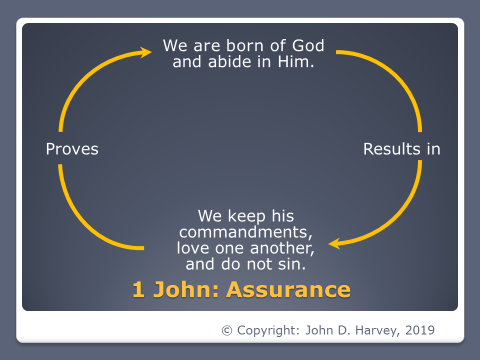
1 John teaches two central truths about God: God is love (1 John 1:5), and God is light (1 John 4:7-8). Each has important implications—one about our status; the other about our conduct. In a nutshell: Whose we determine results in what we do, which proves whose we are. Together, these truths give us the assurance Scripture promises. Two graphics summarize John’s teaching on assurance.


Thursday, July 18, 2019

Dean's Devos: "Be Sure To Count Your Blessings"


Ephesians 1:3-14 is one of my favorite passages. It reminds us that we should praise God because he has blessed us with every spiritual blessing in Christ. The list is long, but it includes four special blessings. Why not take a minute and read the verses noted? Perhaps you will be encouraged by what you read.

Blessing #1: Before there was time God chose us in Christ (1:4-6).
Perhaps you feel as though no one loves you or cares about you. If that’s the way you feel, be encouraged: God cared enough about you to choose you with the specific purpose of making you holy and blameless so that you could have fellowship with him. Surely that’s a reason to praise God.

Blessing #2: In the fulness of time, God redeemed us in Christ (1:7-10).

Perhaps you feel as though God could never be interested in you because your past is too nasty or your present is too messy. If that’s the way you feel, be encouraged: You are worth enough to God that he sent his son to pay a price you could never pay. Surely that’s a reason to praise God.


Blessing #3: At just the right time, God claimed us in Christ (1:11-12).
Perhaps you feel as though you have no purpose or life has no point. If that’s the way you feel, be encouraged: God claimed you as his possession, and his claim check was the cross of Jesus Christ. Surely that’s a reason to praise God.

Blessing #4: For all time, God sealed us in Christ (1:13-14).

Perhaps you feel uncertain about the future or are troubled by doubts. If that’s how you feel, be encouraged: Your future is guaranteed for all time because the Holy Spirit who indwells you is the downpayment of your final redemption. Surely that’s a reason to praise God.

Ephesians 1:4-6 New International Version

"For he chose us in him before the creation of the world to be holy and blameless in his sight. In love he predestined us for adoption to sonship through Jesus Christ, in accordance with his pleasure and will to the praise of his glorious grace, which he has freely given us in the One he loves."